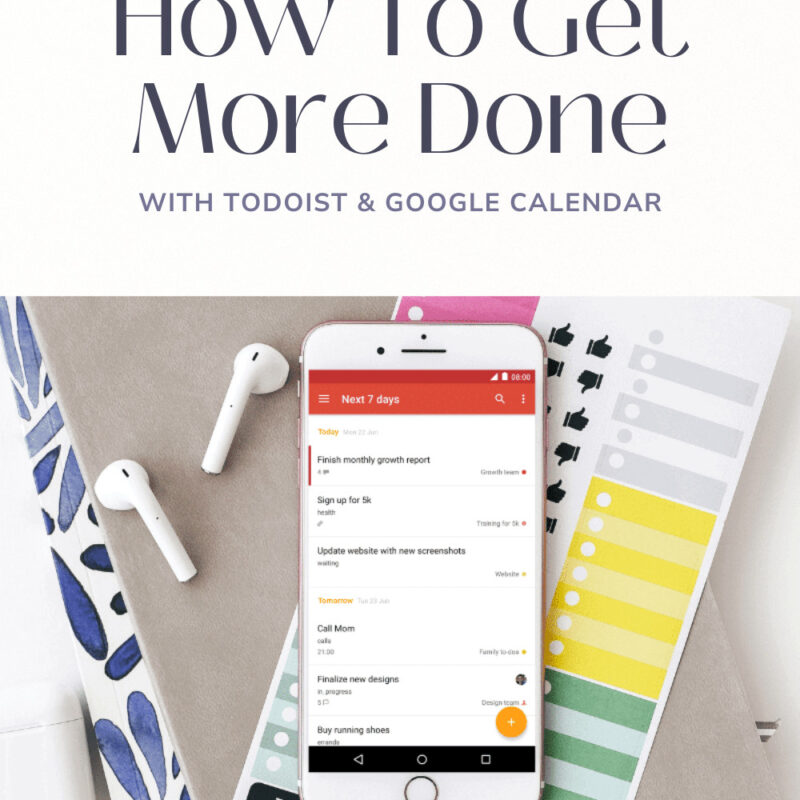
Master Task Management with ToDoist and Google Calendar
Disclosure: this post may contain affiliate links, meaning, at no additional cost to you, i may earn a small commission from any purchases made through them
Starting and growing an online business is an exciting and fulfilling venture (or at least it has been for me). From writing your business plan, launching your website and services, landing your first client and turning your idea into a full-time business with multiple projects and moving parts. You are doing the thing!
However, if you’re also like me, eventually you will need software or a system to help you organize your growing list of tasks, projects, and clients while improving your efficiency and time management skills (because time is money!).
Several years ago I was introduced to the task management system called ToDoist. It was recommended by Thomas Frank in his Productivity Masterclass on Skillshare (if it came from the king of productivity systems I had to try it)!
And…I’ve been using ToDoist consistently, for several years now.
It’s still my favourite productivity tool, even after testing others that get raved about (errhhmmm…ClickUp – way to complicated).
In this article, I’m going to share some of my favourite ToDoist features that small business owners (and Pinterest Managers) can use to make their task management more efficient.
Plus, I’ll show you step-by-step how to integrate your ToDoist with your Google Calendar for time blocking.
Let’s go!
Why Do You Need A Task Management System?
A task management system works to benefit your business in the same way that a grocery list or Post-it to-do list benefits your personal life.
It helps you stay focused on the important tasks you want to prioritize (eg. that salad instead of the box of cookies over there). Without it, you are more likely to forget things, procrastinate, or spend your time on smaller, less important tasks.
A task management system also helps eliminate decision fatigue by organizing what you need to accomplish each day, week, and month. It streamlines your workflows by helping you track what needs to be done and its status.
Imagine starting each week knowing exactly what business or admin tasks you have on your plate and when to check them off your list. You’ve just eliminated the task of planning your week by organizing it into a system that works for you.
Without a task management system, you are more likely to become inconsistent and overwhelmed.
This ultimately hurts your business (and mental health, let’s be real).
What Does ToDoist Do?
So we’ve covered the benefits of using a task management system in your business workflow, but what the heck is Todoist?
In my experience, it’s your to-do list but in a better format that’s easier to manage (and did I mention it’s completely paperless? No more loose Post-its!).
Todoist is a task management solution that allows you to organize your tasks into projects, add dates, set priority levels (if you have Premium), add labels, and more.
These are conveniently organized in the left navigation bar on the Desktop or hamburger menu on mobile.
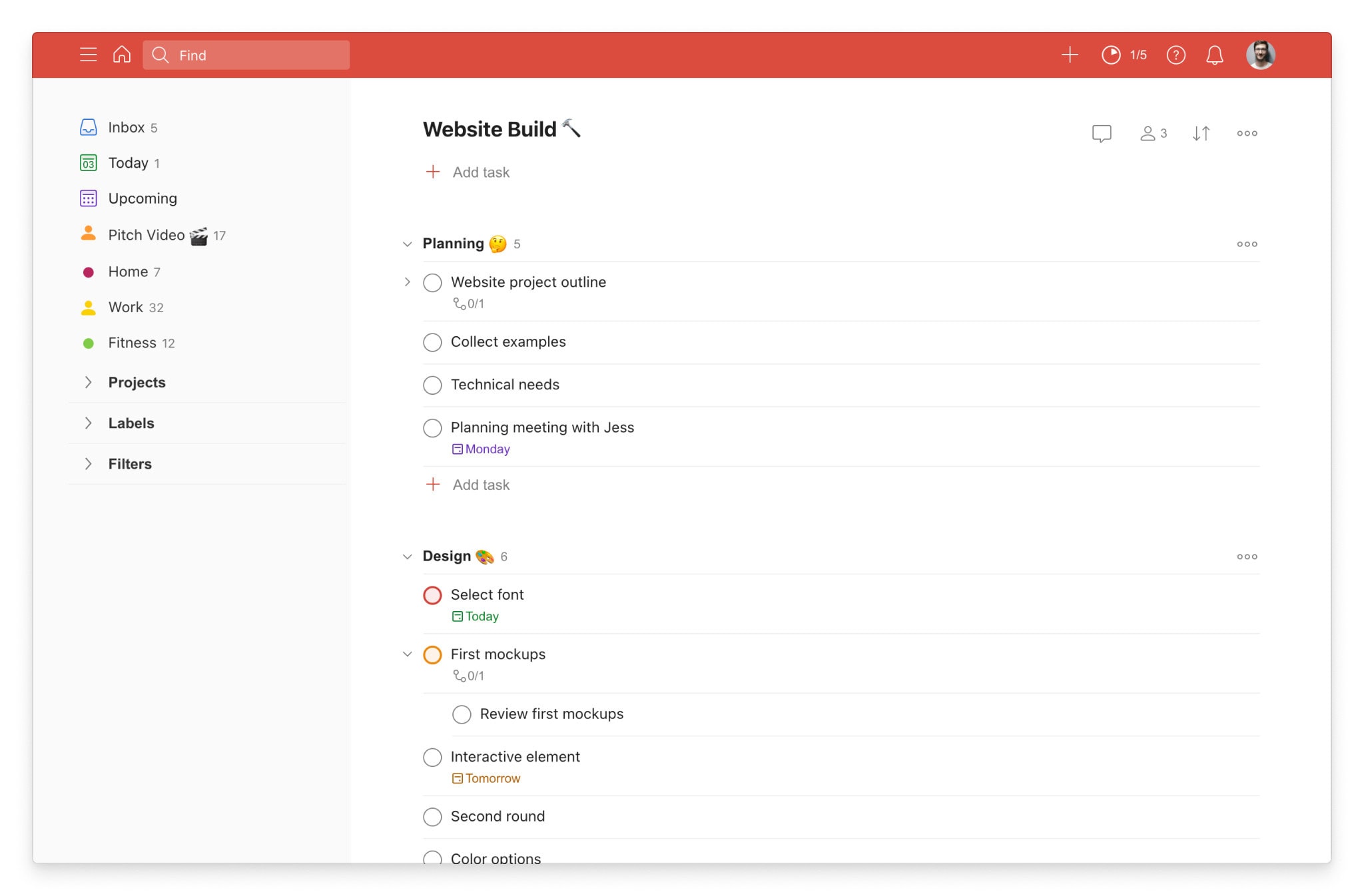
ToDoist has eliminated the problem you get with a single task list (once your list has more than 20 items it becomes unmanageable).
With your tasks organized in ToDoist, you can choose how to approach your tasks each day. Some of the filters I’ve tested are:
- By project
- By date (only show tasks that are scheduled for today)
- By priority level (eg. categorize Today’s tasks by Priority 1, Priority 2, Priority 3, etc)
Furthermore, you can break down your tasks using different views. Depending on how you like to work, you can view your tasks as a simple list, kanban style boards, or calendar.
With ToDoist’s customizations, you can set up a streamlined system that helps you break down everything on your plate into smaller, more manageable projects with due dates, which ultimately helps you stay consistent and prevents tasks from falling through the cracks.
Plus, if you integrate it with your Google Calendar, you can better organize your tasks in blocks (I share further down this article)
ToDoist Features: How ToDoist Helps Me Manage My Tasks List As A Pinterest Manager
ToDoist has several features to explore, including business features for teams. However, I’m focusing on the features I use to manage my workflows as a solo business owner.
ToDoist Makes It Incredibly Easy To Input Tasks
One of my favourite features of Todoist is how easy it is to add tasks to projects, on different days, and on the fly. You don’t have to go to specific sections, you just start writing and Todoist organizes it for you! No joke, it’s that simple.
You can create single tasks simply by writing them out with a day of the week (eg. “this Monday”) and submitting them. The Quick Add automation will organize your task where it needs to be with a single click.
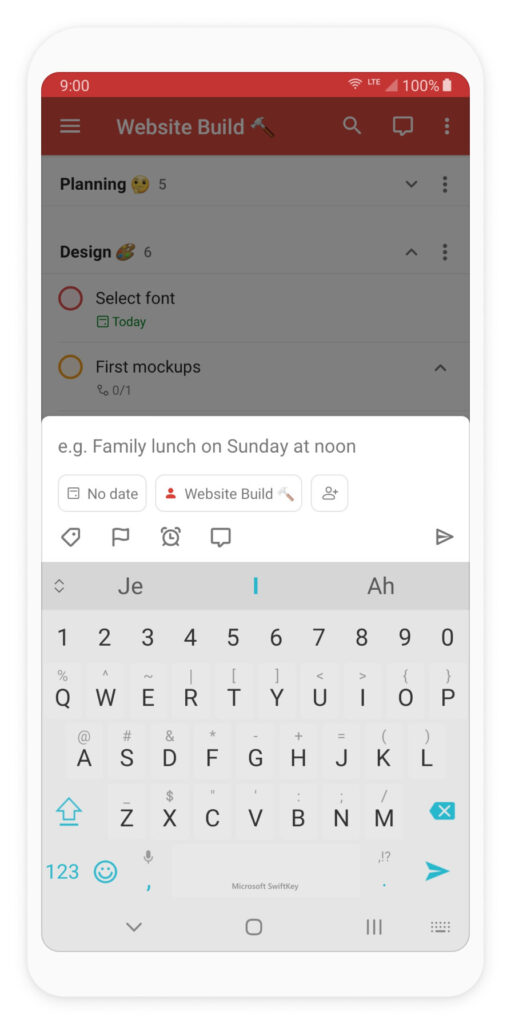
Note, if you input a task without a project it will organize it in your “Inbox”. This is where they keep your uncategorized tasks. This is very convenient if you want to quickly get something off your mind and don’t want to organize it immediately.
Here are some common Quick Add prompts I use to quickly add tasks to ToDoist:
- To set a priority level input P1, P2, P3, or P4. For example: “Send email copy to VA for scheduling tomorrow P2″ will create a task that will appear on your to-do list tomorrow and it will have a Priority 2, which means it will appear higher on the list than lower priority tasks.
- To categorize your task to a project input #. For example: “Follow up with Jane Doe on Friday #JaneDoe” will create a task that will appear on your to-do list on Friday and it will be assigned to Jane Doe’s project.
- To set a due date simply start typing when it’s due. For example: “Design 10 new Pinterest pin designs Tuesday”
Why is this helpful?
You can organize your tasks VERY quickly, saving you time as a business owner. Adding a task to a project feels as easy as sending a quick text message.
Todoist Helps Me Manage Recurring Tasks
I have a lot of recurring tasks in my business and this is one of the ways ToDoist excels for me.
When setting up tasks in a new client project, I will create the recurring tasks and won’t have to think about it ever again! When the time comes that task will appear in my tasks list for that day. When I finish the task and mark it as complete it will switch the date to the next specified date.
Using their Quick Add automation, creating recurring tasks is incredibly easy. When writing your task you would just add “every” in the sentence.
So for example, I send a monthly analytics report to clients in the first week of each month. However, I focus on different clients on different days. So if I’ve time blocked Tuesday mornings for Client A, I would input into ToDoist “Send monthly analytics report on the first tuesday of every month #Client A”.
It will know how to input it and you don’t have to worry about it!
ToDoist Helps Me Organize My Projects and Clients
One of the ways I’ve learned to use ToDoist over the years is by creating projects for each client I am working with.
As a Pinterest manager, I am working with multiple clients at a time. For each of them, I need to track the onboarding process, and once management begins, when to design new Pinterest pins, when to schedule them, when I need to track analytics, when I need to check in with them, etc.
When you’re managing these tasks for 8+ clients, while also completing account set ups, and hopping on consult calls, you need to stay on top of it!
Opening my ToDoist each day and seeing which clients and which tasks I’m focusing on that day helps to streamline my workflow so I’m not scrambling to figure out my goals for the day.
Todoist helps me build productive habits
With the ability to schedule recurring tasks and a simple Quick Add input, Todoist makes it easy to build habits and avoid decision fatigue.
While Post-it lists are great they aren’t as organized as Todoist. Tasks written on a piece of paper can sit on your list forever because there is no defined deadline. In that way, Todoist is closer to a calendar but not as strict.
Tasks are more likely to get done because they can have a defined date or time. You are also less likely to forget with automated reminders.
For example, to maintain a habit of updating my monthly bookkeeping, I’ve added a bi-weekly bookkeeping task to my admin project. I need that reminder or I will procrastinate until it’s tax time and I’m scrambling to catch up!

Time Blocking: How To Integrate Your ToDoist With Google Calendar
ToDoist recently added a Calendar view to the tool, but I still prefer my Google Calendar integration system.
Google Calendar allows you to colour code by the project (or Calendar) and events aren’t exclusive to what’s in ToDoist.
One of my favourite reasons to integrate my projects with Google Calendar is for time blocking (this is one area ToDoist could improve on, but isn’t necessary.)
Without Google Calendar, it’s hard to visualize how your projects/tasks fit into your week and how you are going to structure them. You can add dates and times to the task, but it remains a list after all.
The Calendar integration provides a visual look at your task lists so you can block your time more efficiently and improve your time management.
I like to group tasks by project/client. I can visualize the time I need to complete a group of tasks and block a chunk of time accordingly.
Here is how I do it.
Step 1: Set Up Your Project In Todoist
On Desktop, open ToDoist.
In the left side menu, hover over My Projects, hit the plus symbol and Add Project.
Name your project, choose a colour and then hit Add.
Step 2: Duplicate This Project As A Google Calendar
On Desktop, open Google Calendar.
At the top of the screen select the “cog” symbol and Settings.
In the left side menu, scroll to Add Calendar and then Create New Calendar
Name the Calendar the same as your Todoist project and then hit Create Calendar.
Step 3: Integrate Your Project and Calendar Inside ToDoist
Head back to your ToDoist.
Click on your profile picture in the top left of the screen and select Settings. A window will open.
In the left sidebar select Integrations.
Select Add a Google Calendar. A window will open. This is where you will create the connection between the Todoist project and the Calendar you just created.

In the open window, make these selections:
- Google Calendar = choose the calendar you just created
- Sync = a specific project
- ToDoist Project = choose the Todoist project you just created
- Todoist label for new Google events = erase what’s in here
- Google event duration = I choose 30 minutes and adjust directly in Google Calendar (I will explain in Step 4)
- Todoist tasks without a start time or duration = Sync
- Completed Todoist tasks = Are removed from Google Calendar (when I’m done I like them to disappear off my calendar so all that’s left is unfinished tasks)
Hit Connect.
Your Todoist project and Google Calendar should be synced now.
Any tasks that you add to this project inside ToDoist should appear on your Google Calendar.
If you don’t add a time to the task they will appear as an all-day event. This is okay. I usually go into Google Calendar after and drag them to specific times to create my time blocks.
Step 3: Adjust Time Blocks In Google Calendar
Once your tasks are added to your ToDoist project you can start to adjust your Calendar.
In Google Calendar, drag tasks to the time you want to focus on them. Adjust the length of the task based on how much time you need to complete it.
If you are adjusting recurring tasks, Google Calendar will ask you if you are editing “this event” “events following” or “all events”. To make sure your task appears in the same block each time, choose “all events” “or events following”.
Change the colour of the tasks according to your time blocks. I use a different colour for each project and time block based on the project, but you might prefer to time block similar tasks together or another method.
Conclusion:
Until discovering Thomas Frank’s productivity course I thought I had a good system. However, after getting used to Todoist I realized I wasn’t working as efficiently as I could. Now that I manage my tasks in the app, I make fewer decisions throughout the day which ultimately causes less stress in my life and less time wasted.
I currently use the premium version of the app but you don’t have to upgrade to get the benefits of using this task management system.
If you would like to test Todoist to see if it vibes with you as well you can sign up here or learn more from their website.